
Equipment & Production Capabilitiesinsights
2026年2月2日
Why Static Control Is the Hidden Champion in Robotic IML — A Label Manufacturer’s Perspective
Learn why static control is the key failure point in robotic IML and how label manufacturers engineer materials to stabilize automation, improve OEE, and reduce scrap.
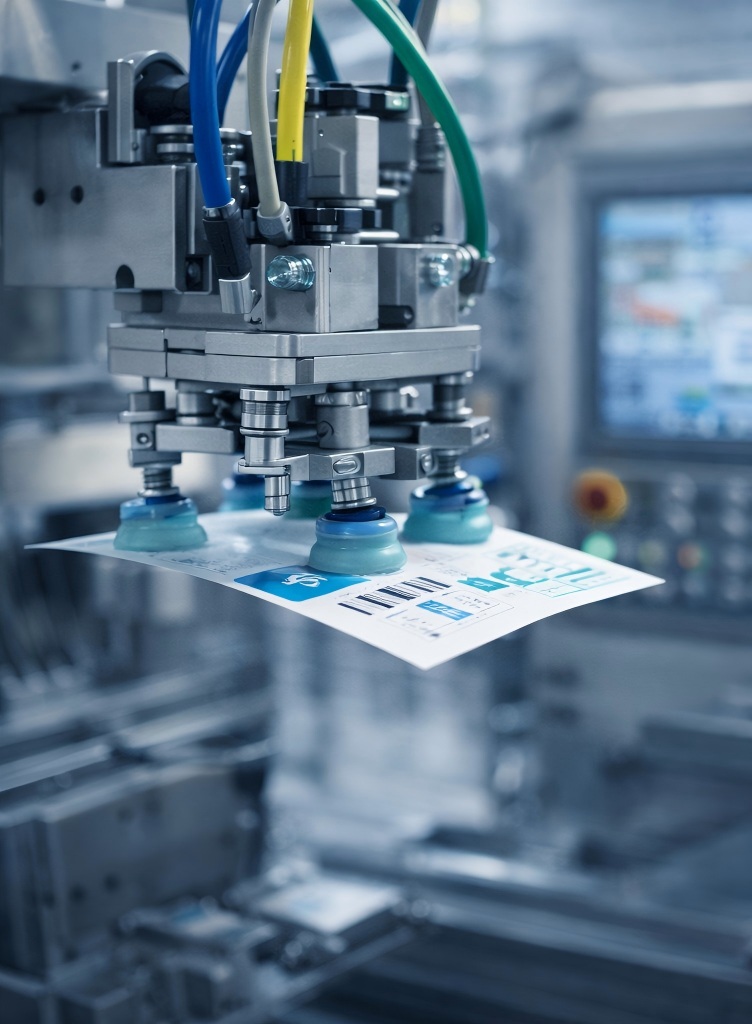
Basic tasks: reliably handling a thin plastic label.
In most robotic IML systems, this failure is not caused by software, mechanics, or programming errors. It is caused by an invisible force: static electricity.
In automated in-mold labeling, static control is not a peripheral consideration. It is a core engineering variable that directly affects label feeding, robotic pickup, mold placement accuracy, and overall system stability.
From a label manufacturer’s perspective, uncontrolled static is the single most common root cause behind robotic IML instability.
This article explains:
- Why static electricity disrupts robotic IML systems
- How static accumulates throughout the label lifecycle
- What active and passive countermeasures exist
- And how label manufacturers reduce static risks before automation even begins
🔍 Static electricity is the leading cause of handling and placement failures in robotic IML systems. ✅
Friction during label separation, feeding, and robotic handling generates an electrostatic charge that directly interferes with automation stability.
How Static Electricity Disrupts Robotic IML Before Injection Even Starts?
In robotic IML, static charge turns labels into unpredictable objects.
Charged labels may attract each other, repel robotic grippers, drift during mold placement, or attract airborne contamination—all before plastic injection begins.
From an automation standpoint, robots behave consistently.
From a material standpoint, labels under static influence do not.
This mismatch is what causes robotic IML systems to appear unstable, even when the mechanical setup is correct.
Failure Stage | Static-Related Cause | Result | Production Impact |
|---|---|---|---|
Label De-stacking | Electrostatic attraction between labels | Feeder jam or mispick | Line stoppage |
Robotic Pick-up | Electrostatic repulsion or over-attraction | Missed or double pickup | Cycle interruption |
Mold Placement | Electrostatic drift inside the cavity | Misaligned label | Cosmetic reject |
Contamination | Electrostatic dust attraction | Embedded particles | Quality scrap |
Active and Passive Static Control Methods in Robotic IML Systems
While automation equipment enables static neutralization, label behavior determines how much static must be managed in the first place.
Can Labels Be Engineered to Reduce Static Before Automation?
For robotic IML systems, static control does not begin on the factory floor—it begins during label material engineering.
The challenge for label manufacturers is not eliminating static alone, but balancing anti-static performance with printability, molding compatibility, and long-term stability.
Is Humidity Control a Primary Solution or a Supporting Condition?
In high-speed robotic IML, no single static control method is sufficient on its own.
Stable automation is achieved when:
- Labels are engineered to minimize static generation
- Environmental conditions prevent extreme charge accumulation
- Equipment is properly grounded
- Ionization is applied precisely at critical handling points
From a label manufacturer’s perspective, static control is not a device—it is a system.
This article is part of CPP’s Label-Driven Robotic IML Automation series, exploring how in-mold label manufacturing decisions directly affect robotic automation stability, efficiency, and long-term performance.